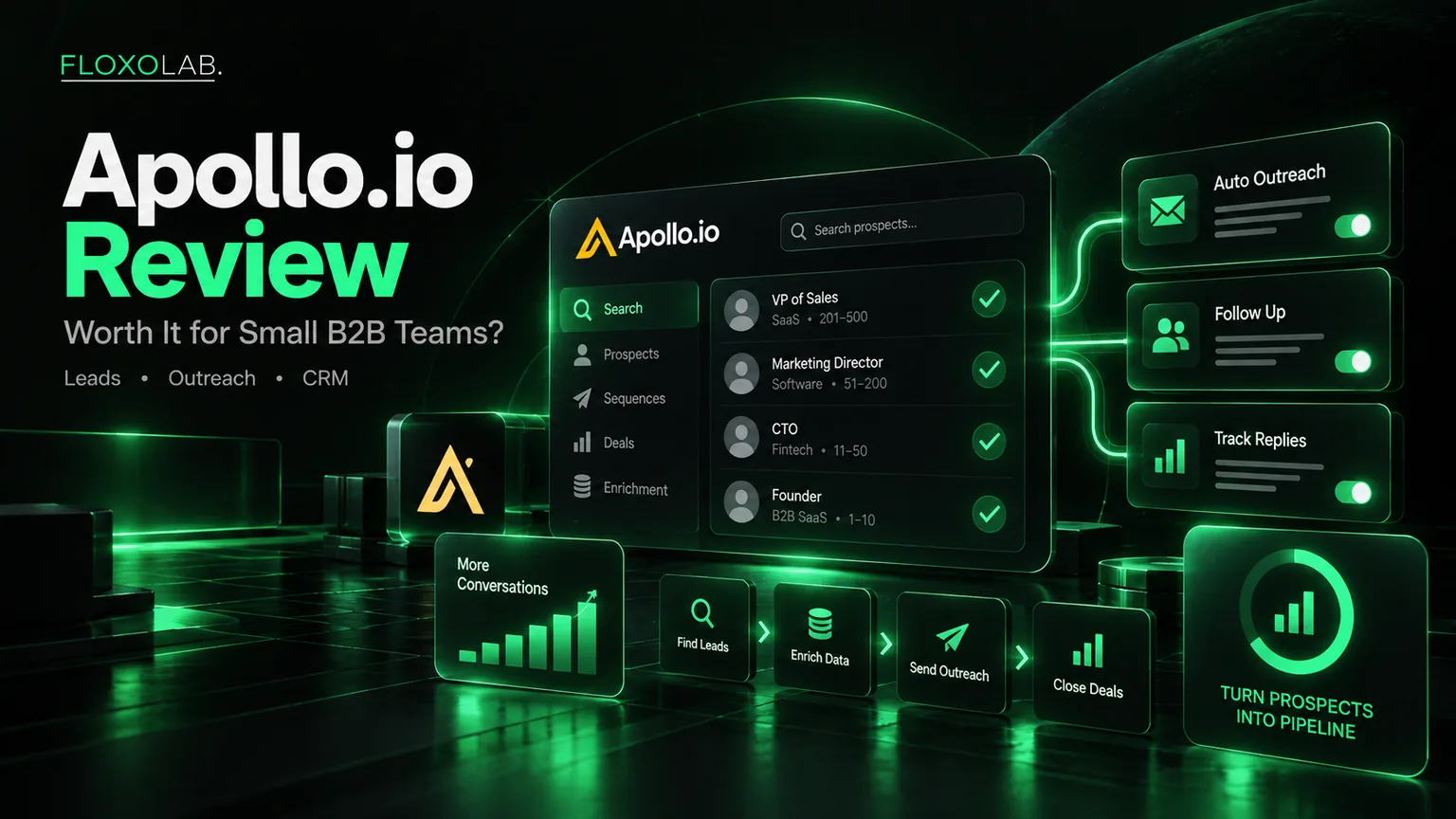
Direct answer: Apollo is worth paying for when a solo operator or small B2B team has a clearly defined market and needs several prospecting steps in one place. It is not worth paying for because the database is large or the feature list is long. The deciding evidence is whether a small sample produces current, relevant, manually verified records at an acceptable total workflow cost, and you can gather that evidence yourself, on the free plan, before spending anything.
Partner disclosure. This page includes a partner link to Apollo. If you create an account or purchase through it, I may earn a commission at no extra cost to you. It does not change the test below, which is designed to tell you when the answer is no.
This is a decision framework, not a star rating. Ratings age badly and rarely match your market. What follows is the sequence a careful buyer runs: check the plan boundary, define what a usable record means for you, test eight areas on a small sample, then decide. The full plan numbers live in the Apollo pricing guide, the enrichment workflow in the CSV enrichment walkthrough, and the relationship-led comparison in Apollo versus LinkedIn Sales Navigator.
What a seat actually costs today
Checked on Apollo's public pricing page on September 19, 2026. Apollo labels this introductory pricing and states that features and pricing may change, so re-check before you buy.
| Plan | Monthly pricing view | Credits per seat per month | Annual pricing view |
|---|---|---|---|
| Free | $0 | 75 | $0 |
| Basic | $65 per seat | 2,500 | $49 per seat |
| Professional | $99 per seat | 4,000 | $79 per seat |
| Organization | $149 per seat, annual commitment | 6,000 | $119 per seat, minimum 3 seats |
Two things matter more than the headline price. Credits, not seats, are what you run out of: the real cost depends on your mix of emails, phone numbers, enrichment, research, and exports. And annual billing currently cuts the per-seat rate by roughly 20 to 25 percent, which only helps if you already know the tool works for your market. That is exactly what you do not know yet.
Apollo partner link
Start on the free plan, not a paid seat
Partner disclosure: I may earn a commission if you create an account or purchase through this link, at no extra cost to you.
Who should put Apollo on the shortlist
| Situation | Why Apollo may fit | What to prove first |
|---|---|---|
| Solo B2B consultant with a narrow market | Search, list building, contact fields, and a small outreach workflow sit in one place instead of three tools. | A 20-company sample with current roles, usable business contacts, and a clean export. |
| Small agency building repeatable account lists | Saved targeting rules cut the setup work you repeat for every client. | Two client segments that stay separated, reviewable, and free of obvious duplicates. |
| Operator enriching an owned CRM or CSV | Native enrichment may replace manual lookup or a separate provider. | Credit preview, before-and-after fields, match and no-match outcomes, duplicate handling. |
| Small sales team that needs controlled sequences | Prospect data and outreach tasks share one surface. | One campaign configured with suppression, opt-out, bounce, reply, and stop rules. |
| Team replacing several lightly used tools | Consolidation removes contracts, exports, and field mapping. | A same-period cost comparison that counts the tools you would drop and the operator time. |
Who should not buy Apollo yet
The honest half of any buying guide is the part that tells you to keep your money.
- You cannot yet define your ideal customer profile, role set, exclusions, and required fields. The tool will not define them for you.
- You need consumer leads. This is B2B account discovery.
- Your sales motion runs on warm relationships and professional context. That is a different product category.
- You already have a trusted prospect source and only need email finding or campaign execution. Buy the narrow tool.
- Your market is small enough that manual research and a CRM are genuinely sufficient.
- You expect database access to create legal permission, guaranteed accuracy, deliverability, replies, or revenue. It creates none of those.
- You cannot run a small sample before committing to seats, credits, or an annual term.
Staying on the free plan, or choosing no prospecting platform at all, is a legitimate outcome. The product should remove an observed constraint, not invent a process you did not need.
The eight-area test you run yourself
Run this on a narrow segment you already understand, so you can tell a good result from a bad one. Keep the evidence: the failures are more informative than the successes.
| Area | Test | Pass condition | Failure evidence to keep |
|---|---|---|---|
| Market fit | Search one narrow B2B segment with explicit exclusions. | Enough relevant companies to justify deeper work. | Wrong industries, geographies, company types, sizes, or missing target accounts. |
| Role fit | Find current decision-makers for a manually checked company sample. | Titles and current-company relationships match your acceptance rule. | Former employees, wrong seniority, duplicate people, ambiguous roles. |
| Contact data | Reveal a bounded set of business contact fields. | Accepted fields survive your own verification method. | Missing, stale, personal, or unusable fields. |
| Enrichment | Upload a privacy-safe owned sample after normalizing it. | Credit use is visible and useful fields return without damaging record identity. | No-match records, duplicates, unexpected overwrites, rejected results. |
| Credits | Record every action and preview that affects the allowance. | Your expected monthly workflow fits the plan you would actually buy. | Expensive field types, unexpected consumption, blocked actions. |
| Sequences | Configure a small campaign without launching bulk outreach. | Suppression, opt-out, reply, bounce, and stop behaviour are controllable. | Missing safeguards, confusing defaults, required companion tools. |
| Usability | Repeat the workflow from saved criteria to a reviewable handoff. | You can maintain it without undocumented steps. | Fragile filters, export cleanup, repeated manual repair. |
| Recovery | Use the help centre on one realistic failure path. | You can diagnose the problem and keep your work. | Unclear documentation, irreversible behaviour. |
Eight areas sounds like a lot. In practice it is an afternoon on a 20-record sample, and it is the difference between buying a subscription and buying a year of one.
Where consolidation helps, and where it does not
Apollo's argument for a small team is integration: company and people search, business contact data, enrichment, saved lists, exports, and outreach on one surface. When the same person owns several of those steps, fewer handoffs means less field mapping and less time moving records between tools. That is a real operational saving, and it is the main reason to prefer a platform over three point tools.
The argument weakens in predictable places. Database coverage and data quality vary by market, role, and field. A label such as verified does not remove your obligation to check current employment and business relevance. Credits make the real cost depend on your action mix rather than a lead count. And some workflows still need a separate mailbox, verifier, or CRM, which quietly returns the handoffs you were trying to remove.
A feature you do not use is not value. Count only the steps that replace something you do today.
Free plan, paid trial, upgrade
Use the free plan to define the segment, inspect search behaviour, save a small sample, and prepare your acceptance rule. Do not use it to conclude that a paid feature works: several actions are gated, and the enrichment guide documents one case where CSV enrichment was unavailable on a free workspace. What the free route can and cannot settle is covered in the free trial guide.
Activate a paid trial only when your workflow, sample, and pass conditions are ready, so the clock runs on testing rather than setup. Then upgrade only if all four conditions hold:
- market and role results are relevant enough for your segment;
- the paid action solves a gap you can name;
- credits plus companion tools produce an acceptable cost per accepted record;
- you can maintain verification, suppression, and failure handling.
If one fails, revert, stay free, test an alternative, or keep the smaller manual workflow. One failed condition is enough.
How it compares, briefly
Apollo is the integrated-workflow candidate. LinkedIn Sales Navigator is the relationship and professional-context candidate, and the direct comparison covers that choice properly. Focused providers win when the missing job is only email finding, contact data, enrichment, or campaign execution. If you cannot name which job is failing, the comparison is premature. Start with what a qualified prospect list actually contains.
What not to do
- Do not treat vendor database size or coverage claims as measured accuracy.
- Do not count every revealed record as usable.
- Do not buy an annual term to get the discount before the sample passes.
- Do not ignore credits, companion tools, review labour, or billing commitment when comparing cost.
- Do not launch real outreach merely to finish your evaluation.
- Do not treat access to business data as permission to contact a person.
The decision
Apollo fits a solo operator or small B2B team with a narrow market and several connected prospecting steps. Its advantage is operational consolidation, not a promise that every record is accurate, and not a reason to move every sales task onto one platform.
Start free and prepare properly. Use a paid trial for a bounded question that can change your answer. Buy only when the manually accepted output, credit model, companion-tool cost, and operator effort beat your realistic alternative. If they do not, the correct outcome is to keep your money, and that outcome is common enough that any guide refusing to mention it is not helping you.
Sources checked
Plan names, prices, and credit allowances were read from Apollo's public pricing page on September 19, 2026, on both the monthly and annual billing views. Apollo labels the current structure as introductory pricing and states it may change. This page describes a method for evaluating the product; it does not report a hands-on test, and no rating or accuracy percentage is claimed.
- Apollo pricing: plans, per-seat cost, and credit allowances
- Apollo Help: how credit usage is counted
- Apollo terms: data limitations and lawful-use responsibility
- Apollo privacy policy: business-contact data handling
Apollo partner link
Run the eight-area test before you pay
Partner disclosure: I may earn a commission if you create an account or purchase through this link, at no extra cost to you.