
Claude Ship is Anthropic's workflow for getting GitHub pull requests ready to merge. OpenAI Codex is a broader coding agent that can implement changes, fix bugs, review pull requests and work in CI. The most useful comparison starts with the bottleneck. If an existing PR is stuck between review, fixes and approval, look at Claude Ship's repository workflow. If you need to turn a task into a patch or choose what your own CI job does, compare Codex on those steps. Anthropic's announcement · OpenAI's GitHub review documentation
Updated and fact-checked . This comparison covers documented behavior and provides hypothetical pilots.
Key takeaways
- Claude Ship coordinates GitHub review, fixes and policy decisions.
- Codex can work earlier on a change or inside a CI job.
- Account access, commit permissions and approval rules vary by surface.
Which tool should you start with?
| Use case | Starting point |
|---|---|
| Implement a feature from an issue | Codex |
| Fix a reproducible application bug | Codex |
| Review an existing GitHub PR | Either |
| Address recurring PR feedback automatically | Claude Ship PR Steward |
| Evaluate repository approval policies | Claude Approvals |
| Run custom AI tasks inside CI | Codex or Claude Code with a configured CI integration |
| Work solo without a team subscription | Codex or Claude Code /ship, if available on your account |
These recommendations match tools to workflow stages. They are based on documented capabilities. For custom CI, compare the Codex GitHub Action and Claude Code GitHub Actions.
What actually launched
Anthropic announced Claude Ship on November 23, 2026 and made it available in beta that day for eligible organizations using GitHub. Its Code Review component was already generally available. PR Steward and Claude Approvals entered public beta. Anthropic also began rolling out the developer-facing /ship command in Claude Code and its desktop app. The repository agents and the command have different permissions and billing. OpenAI first announced its Codex cloud research preview on May 16, 2025. The table below uses OpenAI's current documentation for today's product. Claude Ship docs · Codex launch history
Claude Ship vs OpenAI Codex for pull requests
| Decision | Claude Ship | OpenAI Codex |
|---|---|---|
| Where work begins | The repository workflow acts on a GitHub PR. The separate /ship command starts from a developer's change. | An agent task can start earlier, with an issue or a change request. GitHub Code Review starts with a PR. |
| Who posts findings | Code Review sends inline findings with severity. Admins can choose review depth. | The GitHub integration posts a review on request or automatically when enabled. Repository guidance can refine its focus. |
| Who applies fixes | PR Steward can commit fixes for failed checks, conflicts or review feedback on the PR branch. | A developer can ask Codex for a patch. CI can also run Codex and produce a patch through a configured job. |
| Who decides whether to merge | Claude Approvals evaluates the team's repository policy. GitHub branch rules and required checks still govern merging. | The documented GitHub review posts findings. Keep approval, checks and merge authority in your repository workflow. |
| Who owns CI/CD | Teams retain their CI runners and checks. PR Steward can respond to failures. | The GitHub Action or non-interactive CLI can be used inside CI. The team defines triggers, permissions and what happens to the output. |
Sources for the comparison. Claude Ship documentation · Codex GitHub review · Codex GitHub Action
Two example pull request workflows
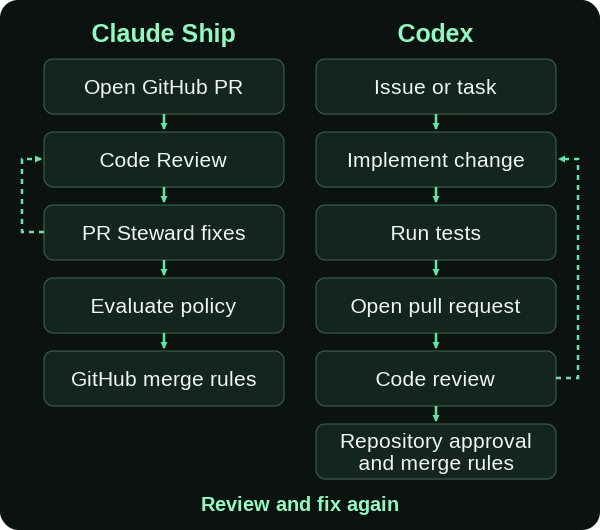
The diagrams illustrate two starting points. Codex can also review an existing GitHub PR, and Claude Code can implement changes before a PR exists.
How approval, fixing and merging differ
Claude Ship gives these jobs to separate agents. Code Review identifies problems. PR Steward can work on a failing check or a review comment and push a corrective commit. It does not approve or merge PRs. Claude Approvals uses the policy stored in the repository to decide where its approval is allowed and where a person is still needed. Observe mode lets a team see those decisions before making the check required. Turning on the organization workflow requires the Owner role. Whether a branch can merge automatically also depends on GitHub settings and whether the policy requires a human. Anthropic's setup and policy notes
Codex Code Review can look at the diff in a local checkout or post findings through GitHub. Turning on automatic GitHub reviews schedules review work. If the job also needs to change code, use a separately scoped Codex task or a CI job that hands a patch to a maintainer. A lint fix, a change to the test and an application bug fix can all turn a check green. The reviewer needs to verify which of those happened. OpenAI code review · Non-interactive mode
The /ship command deserves a separate check. It can commit and push as the signed-in developer and open a PR in supported cases. For GitHub, Anthropic lists Claude Code 2.1.330 or newer and a signed-in GitHub CLI 2.63 or newer. The ongoing watch has its own permission requirements and is unavailable on native Windows. Start with a checkout containing only the proposed changes and inspect what will be published before invoking it. Claude Code command requirements
When a PR can merge automatically. PR Steward can push corrective commits. Approval decisions belong to the policy configured for Claude Approvals, and GitHub controls the merge. The policy check can prevent a merge only when GitHub requires that check. Observe mode generally reports the decision without enforcing it. When auto-merge or a merge queue is configured and all branch rules, checks and approvals pass, a PR can merge without a human review if none is required. An AI approval reflects the configured policy. Maintain appropriate tests and human review for sensitive changes to assess correctness and security. Claude Ship workflow · GitHub auto-merge rules
Availability and pricing
Anthropic's repository-level Claude Ship agents are for Team and Enterprise organizations using GitHub. The launch excludes organizations with Zero Data Retention, the HIPAA configuration or customer-managed encryption keys. The agents draw on separately billed organization token usage. Review depth, review frequency, repeated fixes and policy classifiers can all affect cost. Observe mode can still trigger billed work, including Code Review when a policy calls for it. Anthropic bills /ship as ordinary Claude Code usage. Availability and billing
OpenAI lists Codex access across ChatGPT plans, including Free and Go, with feature-specific plan and workspace limits. Its documented surfaces include the desktop app, CLI, IDE extension and cloud. GitHub reviews draw on Code Review usage, while local reviews count toward general usage. Enabling automatic reviews requires a connected repository and GitHub push or admin permission. The documented GitHub Action uses an API key, so account for API charges and GitHub runner usage separately. For a small team, compare the cost of the same trial PRs across both tools before converting the results into a monthly budget. OpenAI pricing and availability · GitHub Action requirements
For a dated US subscription baseline, Anthropic lists Claude Team Standard at $20 per seat per month on annual billing or $25 billed monthly, with at least two members. OpenAI lists the same Standard seat prices for ChatGPT Business, and ChatGPT Plus at $20 a month for an individual. These are base subscription prices. Compare repository-agent usage, additional credits and any API charges separately. Claude plan pricing · ChatGPT Business pricing · ChatGPT Plus pricing
Billing controls for the repository agents
Claude Approvals has no base fee. Classifier runs and Code Review runs requested by a policy can incur usage charges, including in observe mode. PR Steward starts without a dedicated spending cap until an administrator sets one. Repeated review and fix cycles can increase usage. Turning off organization usage credits leaves enabled agents running and billing. To end that activity, follow Anthropic’s shutdown procedure in order: turn off Claude Approvals, then PR Steward, then Code Review. The local commands are controlled separately. Claude Approvals costs · Agent shutdown procedure
Temporary Enterprise credit offer
On November 23, 2026, Anthropic announced at least US$10,000 in promotional Claude Ship credits for eligible paid Enterprise organizations. An eligible organization can claim once by January 15, 2027 at 23:59 UTC. Credits expire 30 days after claiming or when depleted. The offer has eligibility exclusions and applies to repository agents. Standard billing applies after the credit expires. Launch announcement · Offer eligibility and terms
Two practical pilots
Solo maintainer with a reproducible bug
Use a low-risk issue such as a date formatter handling midnight incorrectly. Write an acceptance check that fails before the change, keep the patch on a separate branch and review whether it addresses the reported behavior. A Codex task fits when the work begins with an issue report. Claude Code's PR tooling is relevant once there is a change worth reviewing. Confirm the account and platform support the mode you plan to use.
Small team with PRs waiting on checks
Choose one low-risk repository and begin with review feedback only. Keep the required test and human approval in force. Ask a maintainer to label each finding accepted, rejected or already known. When assessing fix support, measure how many proposed commits remain after human review and how often feedback creates another review round. Track usage per accepted fix as well as elapsed time. In Claude Ship, compare observe-mode approvals with actual maintainer decisions before making that check required.
The same exercise works if CI stays team-owned and Codex supplies a patch for review. Keep the patch scope narrow, protect credentials and preserve deployment approval separately. The guide to AI agents for business covers permissions and accountability. The human approval workflow guide shows how to make a decision explicit in another kind of automation.
How to measure a pilot
| Metric | Measurement |
|---|---|
| Review precision | Accepted findings ÷ total findings |
| Fix acceptance | Accepted AI-generated fixes ÷ proposed fixes |
| Regression rate | PRs with a trial-introduced regression ÷ PRs evaluated |
| Review cycles | Review and correction rounds per PR |
| Human effort | Maintainer minutes per PR |
| Cost | Tool usage cost per PR, including retries |
| Merge time | Elapsed time from PR creation to merge |
These are proposed evaluation metrics. FloxoLab did not measure them for this comparison. Use comparable changes and the same required checks. Record regressions within a fixed follow-up period. Mark empty denominators as unavailable and report unmerged PRs separately.
How we use AI coding agents at FloxoLab
We used Codex to prepare this bilingual article series in a separate Git worktree, review the English and Spanish sources, and run local checks for canonicals, language alternates and clean URLs before release. A maintainer authorized publication. This example describes our Codex workflow. The Claude Ship comparison draws on vendor documentation. For another example of how we separate a proposed change from permission to act, see our human approval workflow.
When piloting a workflow that retries failed operations, use the same care you would apply to retrying API calls without duplicate effects. Track what ran, what changed and which action a maintainer approved.
Frequently asked questions
Can either tool replace GitHub Actions or deploy by itself?
Neither comparison workflow requires replacing your CI/CD. Claude Ship works with the checks already configured. Codex can be called within a workflow. The repository and deployment system still determine what can be merged or released.
Can both tools review the same pull request?
Yes, if both integrations are available and enabled on that repository. Consolidate duplicate findings and agree on who can write to the branch. A second review adds signals. It does not establish that all bugs have been found.
Is Claude Ship better than Codex?
The tools overlap on review and fixes. Claude Ship coordinates work that happens around a PR. Codex can also start earlier or run a task within your own CI. FloxoLab did not conduct an independent head-to-head test.
What is the difference between Claude Ship and Claude Code?
Claude Code is Anthropic’s coding agent. Claude Ship’s repository agents handle review, fixes and policy checks on GitHub. /ship is a developer command in Claude Code that can prepare a change for review and work on feedback. Claude Code command documentation
Can Claude Ship merge a pull request without human approval?
GitHub can merge it through auto-merge or a merge queue once its requirements pass. Whether a person must approve depends on branch protection, required checks and the approval policy. PR Steward’s role is to propose and push fixes.
Is Claude Ship available on Claude Pro?
The organization agents require Team or Enterprise. Pro includes Claude Code access. Check whether /ship appears in the supported local session for your account and platform before relying on it. Individual Claude Code plans · Command requirements
Can Claude Ship generate unexpected usage costs?
Yes. Repeated reviews, fixes and policy checks can use more tokens than planned. Observe mode may also incur charges. Set the applicable agent spending controls and use Anthropic’s shutdown sequence to stop enabled repository agents.
Which should you start with?
Pick the smallest trial that matches where work stalls. Use Claude Ship's stages if reviewers repeatedly hand a GitHub PR back for routine fixes. Use Codex for an issue-to-patch task or a CI step you want to control. Keep a maintainer responsible for the diff and the release.