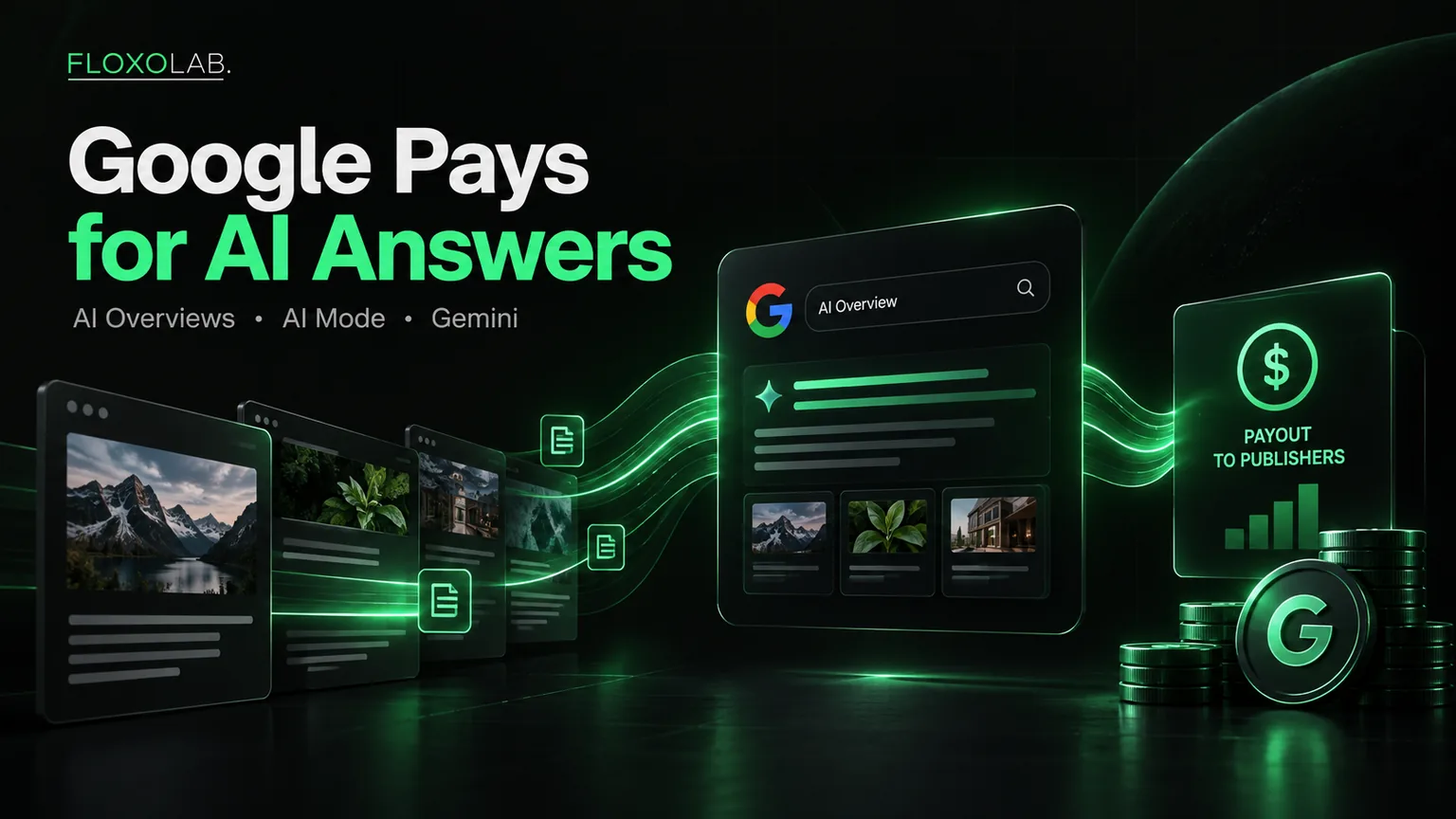
Direct answer: Google is running an invitation-only AI contribution pilot that pays participating sites when their content contributes significantly to answers in the Gemini app, AI Overviews, and AI Mode. Earnings appear in Search Console. You cannot apply, the calculation is undisclosed, and early payouts have been described by participants as small. The pilot still matters, because it is the first time contribution to an AI answer has carried a price.
For twenty years the arrangement was simple. You published something useful, Google sent you visitors, and the visit was the payment. Then AI answers began resolving questions on the results page, and a share of those visits stopped arriving. The industry called it zero-click and mostly complained.
Google is now testing a different arrangement. For participating sites, payment is tied to contributing to the answer itself, rather than to generating a click.
What Google is actually testing
The programme is called the AI contribution pilot, and it lives inside Search Console. Invited sites accept the terms, and a panel appears showing monthly earnings. Google's help text states that you accumulate earnings when your content "contributes significantly to AI-generated responses in participating products". Those products are the Gemini app, AI Overviews, and AI Mode.
The qualifying condition is narrower than most coverage suggests, and it is the part worth reading twice. Payment accrues when your content is used while the answer is being generated. Google's help text draws the line explicitly: web content may also confirm facts or be linked to after a response is generated, "but those instances don't qualify for AI contribution."
Citation is not the unit of payment. Appearing in the source list under a finished AI answer is not what earns. Being used to construct the answer is.
Google framed the intent in June 2026, in a public policy post: it is "piloting a new way to partner with websites whose content meaningfully contributes to the freshness and factuality of generative AI responses through the process of grounding."
Grounding is the operative word. Not ranking, not linking.
What Google has not disclosed
An honest reading requires the gaps as well as the announcement.
- The calculation behind the earnings figure is undisclosed. One participating executive described the process as "quite black box."
- Payment rates have not been published, and one participant characterised early returns as "peanuts" next to ad revenue.
- Participation is by invitation. At least dozens of publishers have been approached; the total is unconfirmed. There is no application form.
- Nothing in the pilot has been announced as a permanent programme.
So treat any advice promising to get you paid, including advice about this pilot, with suspicion. Nobody outside Google knows the formula.
Why this matters more than the payouts suggest
Judge the pilot by the money currently changing hands and you will dismiss it. That would be a mistake.
Until now, appearing inside an AI answer was a soft metric: good for brand, impossible to bank. Attaching a number to it, even a small and opaque number, is the first time that contribution has been treated as an asset rather than a courtesy.
The progression is hard to miss:
traffic → visibility → citations → AI contribution → direct value
Every earlier stage was something you hoped would eventually convert. The last one arrives as a line item in Search Console. That is the signal, not the amount.
So does traffic stop mattering?
No. Anyone telling you clicks are dead is selling something.
Traffic still converts, still builds lists, still lets people decide whether they want to work with you. Nothing here replaces a visitor who lands on your page and gets in touch.
What changes is that the click is no longer the only way content produces value. If this model holds, a page can earn while the reader stays on Google, the scenario that has been pure loss until now. This does not reverse zero-click. It tests whether some of that value can be compensated directly.
If Google has to build an answer, why would it choose your page?
That question is more useful than any checklist, because it is the selection problem the system is actually solving.
Before any of it, the page has to be reachable. If your bot rules block the crawlers that feed AI answers, nothing further on this list applies. Cloudflare's AI bot rules are worth reviewing for how to keep search access open without allowing everything.
An AI answer is then assembled under constraints. The system needs material it can extract cleanly, trust reasonably, and combine with other sources without contradiction. Content that survives that process tends to share a few traits:
- It answers a specific question directly, rather than circling it for six paragraphs before the payoff.
- It contains something unavailable from ten other pages: original data, a first-hand observation, a real comparison, a number you measured.
- It is structured so a machine can locate the answer without interpreting your layout.
- It sits inside a body of related work, so the source looks consistent rather than accidental.
- It is current, because the stated intent rewards freshness and factuality.
Much of that overlaps with writing well for people. That is not a coincidence, and it is why this shift is less alarming than it sounds.
What to do now
You cannot apply, and nobody can hand you the formula. What you can do is become the kind of source the formula is looking for.
- Answer real questions, properly. Take questions your customers actually ask and resolve them in the first hundred words. Padding was always weak writing; now it is also weak extraction.
- Publish what only you could publish. Your pricing observations, your failure cases, your local market knowledge, the thing you learned on the job last month. Generic aggregation gives the system very little reason to choose your page over the original sources.
- Structure for extraction. Headings that describe rather than tease. Direct opening sentences. Lists where the content is genuinely a list. Definitions stated plainly. If a machine has to guess your structure, it will use someone clearer.
- Build depth around subjects you genuinely know, rather than publishing isolated articles. Google has released no calculation criteria, so treat this as ordinary site strategy rather than a known input to the pilot. Its stated interest is content that contributes to the freshness and factuality of an answer, and one article rarely establishes that about a subject.
- Measure where you appear, not only where you rank. Position tracking no longer describes your visibility. Start recording where your pages and brand surface as a source inside AI answers. Our guide on getting cited in AI search covers what that evidence can and cannot prove.
None of these depend on the pilot surviving. They are the same moves that make a site useful to readers, which is why they are worth doing regardless of what Google decides next.
Can small sites benefit, or is this a big-publisher story?
Here the reporting contradicts the obvious assumption.
You would expect a Google payment programme to start with major news brands. It did not. The pilot reaches beyond news publishers, and coverage indicates a focus on small and mid-sized sites across a range of sectors.
That makes sense once you think in terms of grounding rather than prestige. A large publisher is excellent at breaking news and often useless for the specific, practical question a real person asks: what a process costs in a particular market, how a specific tool behaves, what happens when a common setup fails.
Those answers live on small sites with genuine expertise. That is exactly the material a grounded answer needs and cannot invent.
Small does not disqualify you. Generic does.
The bigger shift: from ranking pages to becoming a source
For two decades SEO was a contest for position. You optimised a page, it moved up or down a list, and the list sent traffic.
The contest is changing shape. Increasingly the question is not where does this page rank but does this system rely on this source when it has to be right.
Those reward different things. Ranking rewarded matching a query. Being relied upon rewards being correct, specific, current, and consistent: the qualities of a source rather than a result. The AI contribution pilot is the first time a payment has been attached to that distinction.
What to take from this
The pilot is small, closed, and opaque, and its payouts will not fund anyone's quarter. As a revenue stream it is unimpressive.
As a direction it is hard to ignore. Google has started paying for content that grounds AI answers, which means it has started assigning value to something the industry could previously only estimate.
If your content is clear, specific, genuinely yours, and easy for a system to use correctly, you are already building toward what is being rewarded. That was true before this pilot. It is simply no longer only a theory.
Sources checked
Claims here were checked on September 19, 2026 against Google's own statement and independent reporting. The pilot is early-stage and its terms can change; recheck before relying on any detail.
- Google Public Policy: supporting the information ecosystem (June 18, 2026)
- Search Engine Journal: Google tests paying publishers for AI answers via Search Console
- 9to5Google: AI contribution pilot tests paying websites
- Search Engine Land: Google tests paying publishers for AI Mode, AI Overviews and Gemini
Want your website to be the kind of source AI search relies on?
FloxoLab helps businesses build content that can be found, understood, and cited across search and AI-driven search experiences.
Get an AI Search & SEO Audit