
Shirudo is an open-source Linux security platform from OpenAI and Cisco. Operators can deploy signed, temporary runtime mitigations on prepared Linux systems while they test and distribute permanent software patches. The platform verifies and enforces authorized safeguards. AI can help draft a safeguard, while model inference, antivirus scanning and autonomous vulnerability discovery are separate capabilities. Both companies announced the project on November 23, 2026. The public code is pre-release and its production-target requirements include a specially prepared Linux kernel and TPM 2.0. OpenAI announcement · Cisco announcement · Project repository
Updated and fact-checked .
Key takeaways
- Shirudo adds temporary runtime safeguards during a patch window.
- Its signed loading and TPM measurements give operators evidence about what ran.
- The public project is pre-release and needs a prepared Linux target.
Isovalent engineers had already presented Shirudo on October 6 at Linux Plumbers Conference in Prague. The November announcement introduced the joint open-source project. At the November 26 check, the project FAQ still listed no stable release or supported release branch. Conference program · Shirudo FAQ
Why a temporary shield matters
A patch fixes vulnerable software, but infrastructure teams may still have to test a new build, schedule a rollout and verify the service afterwards. The waiting period is especially awkward for a service that needs to remain online. Blocking a whole operation can also stop legitimate traffic.
Shirudo's approach is to apply a narrower defensive rule at runtime. A rule, or shield, can observe or block a behavior in a particular context. A signed BPF upatch is the unit loaded on a target. A versioned package can group several upatches. Shirudo's terminology. The goal is to reduce exposure during the interval before the durable fix reaches the relevant hosts. That interval still needs a closure date and a person responsible for deploying the patch. OpenAI's explanation · Shirudo README
How Shirudo protects a running Linux system
Runtime enforcement. Shirudo uses eBPF, which lets small, verified programs run at designated points in the Linux kernel. A shield can observe behavior or enforce a focused decision at an appropriate hook. The project also documents signed Java-agent upatches for configured JVMs. Those agents are loaded at JVM startup, so the no-restart description for live eBPF enforcement should not be generalized to initial configuration or every type of shield. Shirudo README
Signing and approval. On a prepared target, Shirudo restricts BPF loading through a signed loader and a configured keyring. The kernel verifies eligible loaders and checks the BPF program. Keeping authority over what is signed gives operators a separate decision point before enforcement. A valid signature establishes provenance under the configured trust policy. It says nothing about whether an authorized rule is correct for the workload.
Measurement and attestation. Shirudo uses a Trusted Platform Module (TPM) to record measurements of the loaded upatch set. A verifier can use TPM-signed evidence to check the target's measured state. That can help distinguish a rule that was approved from a rule recorded as loaded on a host. An operator still needs telemetry to establish whether normal requests kept working. Repository architecture · Project documentation
What Codex did in the demonstration
In Isovalent’s controlled demonstration, Codex helped generate a targeted safeguard for Java4Shell. Isovalent reported that this safeguard blocked the attempted exploitation and that Elasticsearch kept operating without a restart. The observation applies to that demonstration and workload. FloxoLab did not independently reproduce it or test protection against other vulnerabilities. OpenAI announcement · Isovalent’s Elasticsearch demonstration
The example shows where AI fits. A coding agent can help draft a candidate safeguard. The deployed runtime enforces the approved behavior. Compatibility testing, authorization and the decision to withdraw a safeguard remain operational responsibilities. The repository documents the Linux runtime, keys and verification separately from the model that may have helped draft a rule. Shirudo project repository
For another example of where a coding agent can propose changes and policy controls when they take effect, see Claude Ship vs Codex for GitHub pull requests.
What Shirudo Protects Against — and What It Does Not
Shirudo’s security model aims to resist unauthorized BPF changes by a compromised root account without the operator’s signing key. That property depends on a trusted kernel and boot chain, including Secure Boot with a signed, measured unified kernel image. The project’s pre-flight validates only some assumptions, so operators must verify boot and platform configuration separately. A compromise of the signing infrastructure undermines the trust placed in authorized shields.
A valid signature conveys authorization and provenance. Each safeguard still needs review and workload testing. TPM-backed attestation gives a verifier evidence about the measured state under its configured expectations. Other parts of the system and workload require their own checks. The threat model documents gaps, including limits on which reported log fields are authenticated by TPM measurements. Security model · Threat model and documented gaps
Shirudo versus a software patch
| Question | Temporary runtime shield | Permanent software patch |
|---|---|---|
| What changes? | A policy controls selected behavior on a prepared running system. | A corrected version replaces vulnerable code or configuration. |
| When is it useful? | During the gap before the durable fix can be verified and deployed. | Once an appropriate fix is available and can be rolled out safely. |
| What needs verification? | Which targets loaded the shield, what it covers and whether normal work still succeeds. | Which version is installed, whether the defect is fixed and whether the upgraded service is healthy. |
| What ends the work? | Verified patch rollout followed by review and removal of the temporary rule. | Confirmed installation across the affected fleet, including any nodes that missed the first deployment. |
An existing proxy rule, feature toggle or network control may already reduce exposure in some environments. Shirudo adds a way to govern and verify certain host-level mitigations. Which control is appropriate depends on the vulnerable component, what behavior needs to be preserved and what the operator can safely change.
Shirudo vs Other Linux Security Approaches
| Approach | Primary purpose |
|---|---|
| Traditional software patching | Correct vulnerable software. |
| Kernel live patching | Apply supported kernel fixes without a reboot. |
| Runtime security monitoring | Detect suspicious workload behavior. |
| Network and WAF controls | Filter selected network or application requests. |
| Shirudo | Govern signed runtime mitigations and verify their measured state on prepared Linux targets. |
These controls can complement one another. A network filter can limit exposure, monitoring can reveal changes in behavior, and a targeted shield can reduce risk until the permanent patch is deployed. Choose controls based on what they can observe or enforce in your environment.
System requirements, availability and license
The public GitHub repository documents a local VM for evaluation with a software TPM. The documented production-target architecture requires a Linux kernel with the signed-loader ABI and project patches, plus TPM 2.0. The repository says CI runs all test tiers on x86-64, host tests run on arm64, the VM also boots locally on arm64, and target validation for riscv64 is pending. Those are different levels of validation. Check the project requirements for your exact role and architecture. System requirements · Shirudo README
The repository identifies BSD 2-Clause as the main license and says its BPF programs are dual-licensed BSD/GPL. Check per-file notices if redistributing components. The public code and evaluation documentation are available. Their availability does not establish a supported production build for every Linux distribution. Repository license and status
| Component | Requirement or consideration |
|---|---|
| Linux kernel | Signed-loader ABI and Shirudo-specific kernel patches. |
| BPF | Required kernel support, including active BPF LSM and the documented security configuration. |
| TPM | TPM 2.0 on production targets. |
| Secure Boot | Required by the documented security model, with a signed and measured unified kernel image. |
| Signing keys | Protected, operator-controlled signing infrastructure. |
| Evaluation | Isolated evaluation VM with a software TPM. |
| Production readiness | Pre-release. Check the current project status and security assumptions. |
A conventional application package can rely on the host's existing kernel. Shirudo requires a prepared target whose kernel, boot and signing setup meet its assumptions. Confirm the exact environment before assuming that a distribution or cloud server can run it. System requirements · Security model
An example runtime mitigation workflow
How to Evaluate Shirudo Safely
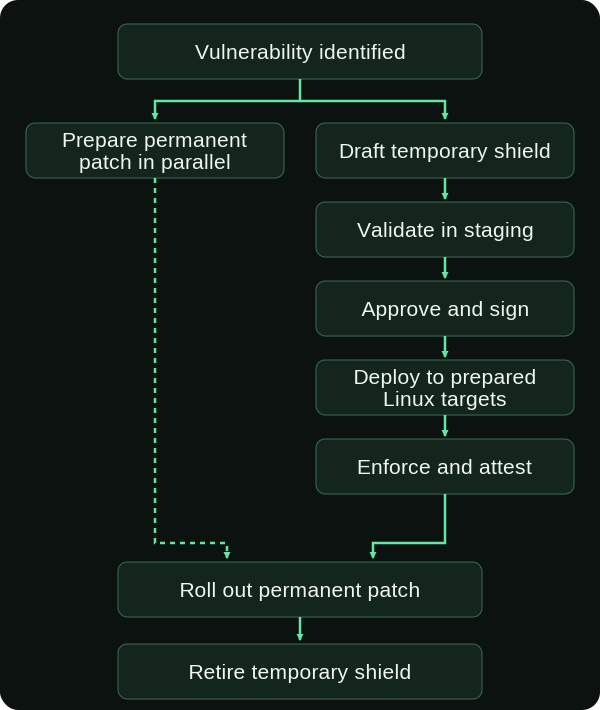
Consider a hypothetical team responsible for an internal Linux service with a maintenance window several days away. The team already has a patch scheduled. Before giving a temporary safeguard any enforcement authority, collect representative successful transactions and expected denied behavior in staging. Decide who approves the rule, which fleet subset is in scope, when the rule expires and what would trigger a rollback. Acceptance should include service health as well as evidence that the approved policy reached its intended hosts.
Teams can apply the same reasoning to short-lived guards for embedded Linux equipment with slow update cycles, or evaluate observation use cases in a prepared container environment. These are prospective applications described by the project and editorial evaluation criteria. They do not represent installations tested for this article. For managed hosting, start by checking who controls the kernel and restart schedule. A site administrator with application-only access typically needs the infrastructure provider to assess host-level options. See the guide to n8n hosting choices and guide to self-hosted recovery for the underlying responsibility and recovery decisions.
Start in an isolated VM or non-production lab. The official VM quickstart uses a software TPM for evaluation. The Isovalent getting-started lab covers the defensive package-verification and measurement workflow. Use the project documentation and GitHub repository to confirm current requirements and status.
- Check the kernel, boot and TPM requirements for both the lab and the intended target.
- Define acceptance criteria for signature verification, measured state and continued legitimate workload behavior.
- Verify the signing and attestation workflow with a known benign workload. Record the workload checks and evidence.
- Rehearse recovery and rollback, including who can authorize removal and how you verify service health afterwards.
FloxoLab reviewed the documents and did not run these labs. Treat any further deployment decision as a separate evaluation against your requirements.
Frequently asked questions
Can Shirudo replace security patching?
Use a shield to cover the update gap. Continue validating and deploying the fix, and retire the temporary safeguard once the updated fleet is verified.
Does Shirudo require a custom Linux kernel?
Current targets require a kernel build with the signed-loader ABI and Shirudo’s patch set. Check the published requirements for the chosen architecture and target role.
Does Shirudo use AI to protect Linux systems?
OpenAI used Codex to help author a shield in its exercise. The signed-loader and attestation architecture does not require that every deployed shield be written by Codex.
Is Shirudo free and open source?
The main project uses BSD 2-Clause, and its BPF programs are dual-licensed BSD/GPL. The repository is available under those licenses. Budget separately for hardware, compatible hosting, operator time and ongoing maintenance.
Can Shirudo run on a VPS?
It depends on whether the provider lets you select the required kernel, configure the boot chain and supply a compatible TPM. Check those controls with the provider before treating a VPS as a candidate target.
Is Shirudo ready for production?
The maintainers label it pre-release, with no stable release or supported release branch. Evaluate the project in a lab and check its platform and security assumptions. Shirudo project FAQ
Does TPM attestation prove that a server is secure?
It provides evidence about specific measured state. Verify the expected measurements, then use workload tests, monitoring and system checks to assess broader security.
What to take away
The release opens an evaluation path for teams that can control their Linux targets and need targeted defenses during a patch delay. Start with the requirements and the trust model, then decide what would count as a successful defensive evaluation for your own workload.