
Start with a page decision. A query in an opportunity table is a reason to inspect your coverage. Before commissioning another article, check whether an existing page already owns the reader's task.
We opened Topics Portfolio for FloxoLab on October 19, 2026. The useful discovery was not a new keyword list: one opportunity overlapped our existing AI visibility audit, while another was too broad to justify a new page. Below, we show the actual report and how we turned those rows into different editorial decisions.
What changed from ordinary AI Performance?
Microsoft announced Topics Portfolio (Beta) on October 13, 2026. It adds personalized topic clusters and opportunity discovery to AI Performance's query/page citation view.
For the baseline reports and counting differences, see our Google AI report versus Bing comparison. This guide focuses on the next decision: what content work is justified by the topic view?
Open the report and preserve its context
- In Bing Webmaster Tools, select the relevant website and open AI Performance.
- Open the topic tab. In our account it was labelled Topic Portfolio BETA, singular, rather than the plural name in the announcement.
- Choose a reporting window and record its visible label before examining a row.
- Open a relevant topic and compare the two query tables. Keep the same period when recording your observations.
Our captures use 3M (Jul–Sep), viewed on October 19. That is historical reporting context, not October activity or a claim about daily freshness. The other visible choices were 1M (Sep) and 2M (Aug–Sep). Record what your interface actually offers.
Read Topic Size, Sites Cited and Queries
Microsoft defines these as approximate ecosystem measures for the selected topic and period:
| Column | Meaning | Safe use |
|---|---|---|
| Topic Size | Citations across all sites. | Select a theme to investigate; do not forecast your visits from it. |
| Sites Cited | Number of sites appearing for the topic's queries. | Consider the breadth of participation; inspect relevance before calling every site a competitor. |
| Queries | Distinct grounding queries in the topic. | Explore reader tasks; do not turn the count into an article quota. |
Our SEO topic displayed 100M–500M Topic Size, 10K–50K Sites Cited and 50K–100K Queries. None of those ranges is FloxoLab traffic. Inside the topic, the separate Your Citations card displayed 6.6K. Keeping these scopes separate prevents the largest number on the screen from becoming a misleading performance headline.
Our real portfolio: five themes, different editorial value
FloxoLab's portfolio contained five rows: SEO & Search Optimization, Backup & Recovery Software, Small Business, Technical Support & Troubleshooting, and Technology. The broad Technology and Technical Support topics each displayed 1B–5B Topic Size. We chose the narrower SEO topic for this walkthrough because it maps more directly to our editorial work.
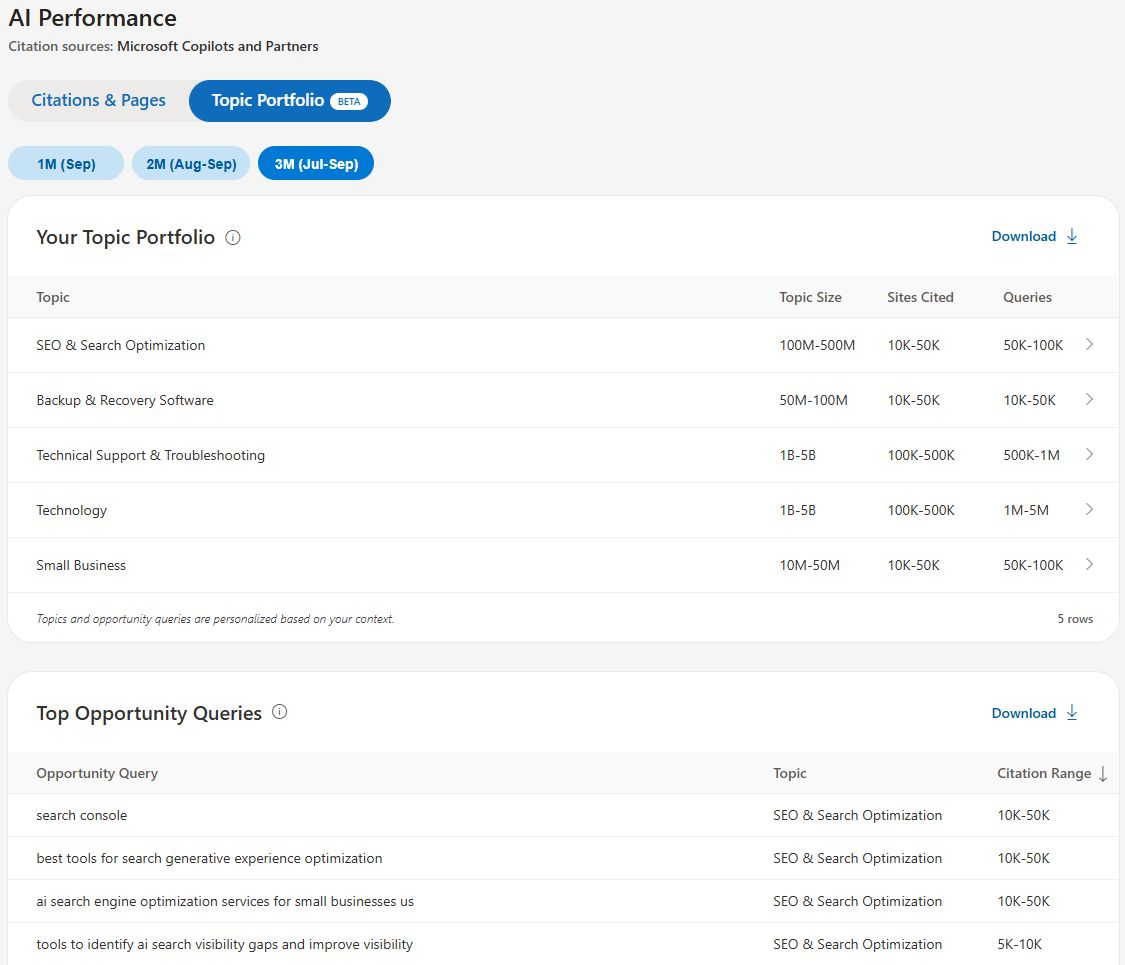
That choice is our editorial judgment, not a ranking of Bing's topic quality. A broad label can contain relevant queries, but the biggest topic does not automatically provide the most useful next page. We also cannot infer from the Backup & Recovery label which FloxoLab URL supplied the signal without checking page-level evidence.
Grounding Queries versus Opportunity Queries
Your Grounding Queries shows existing site presence; Opportunity Queries shows queries where other sites appear without yours. Top Opportunity Queries is the portfolio-wide list. Microsoft presents opportunity citation volumes as ranges.
In our SEO detail view, the left table was labelled Your Grounding Query. Its first three rows were “zero-click search impact measurement tools evaluation” (2.4K), “tools measuring zero-click search impact” (1.5K), and “zero-click search impact measurement tools” (1.2K). Those are displayed values, including Bing's rounding.
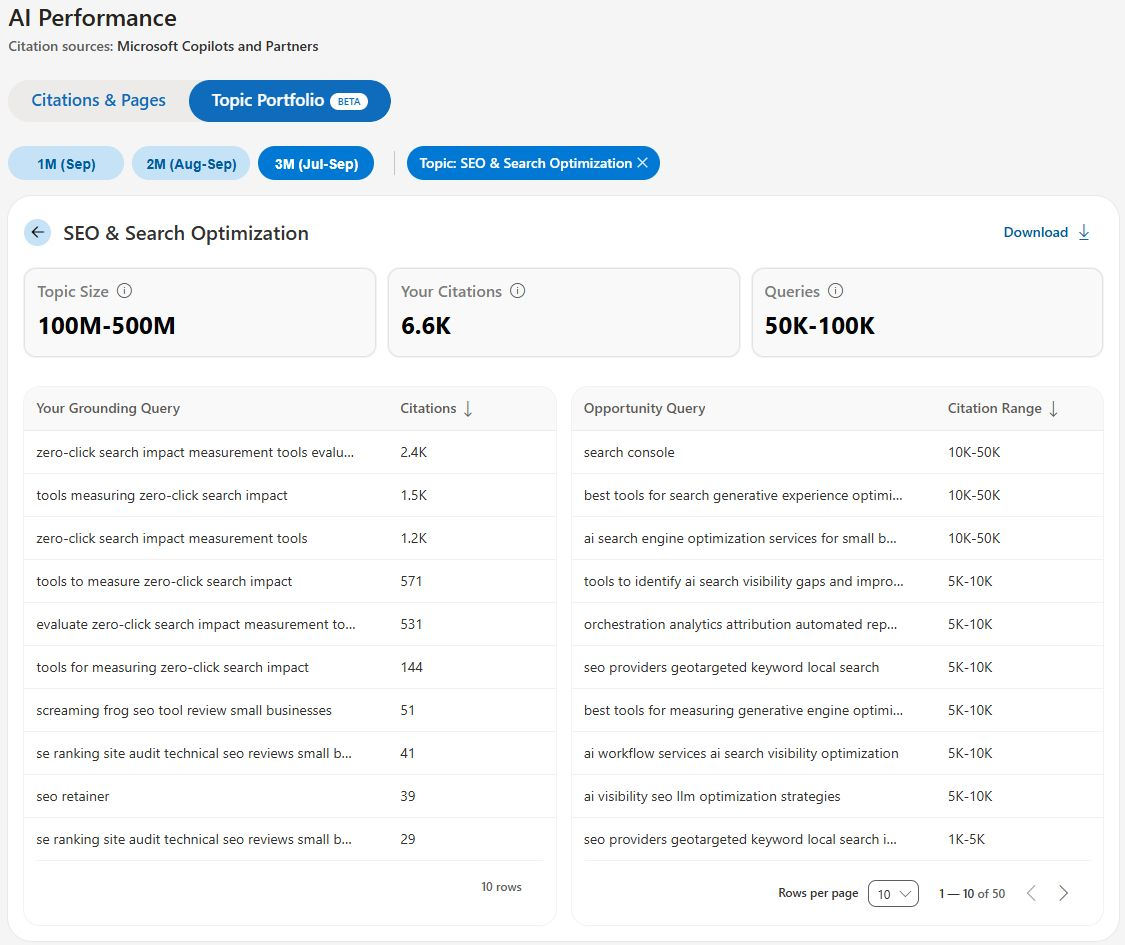
The repeated zero-click phrasing suggests a concentrated reader task worth protecting. It does not justify three new articles with slightly different titles. Our existing zero-click measurement guide is the natural coverage candidate to inspect. This topic screen does not itself attribute each row to that URL, so we are not presenting the 6.6K topic total as the page's total.
Turn a content gap into an action: our actual shortlist
We reviewed the opportunity labels against FloxoLab's current page coverage. The following are editorial decisions from that review, not changes already implemented in those pages or measured improvements.
| Observed query | Existing page to review | Decision | Reason |
|---|---|---|---|
| tools to identify ai search visibility gaps and improve visibility | AI search visibility audit | Investigate the existing guide; update if its tool guidance is insufficient. | The reader task overlaps existing coverage. Check for a specific missing answer before adding another URL. |
| search console | Search Console inspection guide and Google/Bing report comparison | Defer a new generic page. | The broad phrase does not identify a distinct task that our current guides fail to serve. |
| ai search engine optimization services for small businesses us | Search visibility services — general offer, not a dedicated US page. | Defer a US-specific landing page. | A geographic query alone does not establish service scope or the proof needed for that market. |
1. Investigate an existing page before adding a duplicate
The query “tools to identify ai search visibility gaps and improve visibility” appeared with a 5K–10K citation range. Our AI search visibility audit already covers evidence collection, competitor patterns and routing gaps into actions.
Decision: investigate that page first. Its reader task overlaps the opportunity. A useful follow-up would compare its tool-selection guidance with the query's need: can a reader choose a method, record the gap, and decide what to improve? If the answer is weak, add a concrete tool-to-task comparison there. This report alone does not prove that a missing paragraph caused the absence.
A new article needs a genuinely different deliverable. For example, an independently tested tool comparison would require actual comparative evidence. We have not collected that evidence in this walkthrough, so we are not commissioning a “best tools” list just to match the wording.
2. Defer a broad query despite its larger range
“search console” appeared at 10K–50K. FloxoLab already has the Google/Bing comparison and a Search Console inspection guide. The short phrase leaves several possible reader jobs unresolved: navigation, setup, troubleshooting or analysis.
Decision: defer a new generic page. The larger range does not tell us which job we could answer better. We would first need a specific task and a distinct page contract. A title built around this broad phrase would risk competing with existing guides while adding little utility.
3. Check market fit before following a service query
“ai search engine optimization services for small businesses us” also appeared at 10K–50K. The geographic qualifier matters. A provider page needs truthful service scope and relevant proof, not a copied location keyword.
Decision: do not create a US-specific landing page from this row alone. Establish the actual offer and the evidence needed to support it first. The dashboard is a discovery input, not authorization to claim a location, client base or result.
Repeat the workflow on your own site
- Pick a theme you can serve. Prefer a clear connection to your expertise and audience over the largest displayed number.
- Read existing-presence rows first. Write down the reader task they have in common. Avoid fragmenting successful coverage into near-duplicate pages.
- Shortlist relevant opportunity rows. Keep the displayed ranges and period unchanged in your notes.
- Map each row to a URL. Read the actual answer, examples and next action. A keyword search in your page inventory is only the starting point.
- Choose update, new page, investigate or skip. Create a page only when no current URL owns the task and you can add distinct evidence or utility.
- Record a testable next step. State what you will change and what later observation would help evaluate it.
Use our topic-cluster page mapping guide for intent ownership. Bing's topic label should inform your research; you do not need to reproduce its taxonomy in your navigation.
Download the content opportunity worksheet
Record capture date, period, topic, query table, exact query, displayed value, candidate URL, reader task, missing evidence, decision, reason, implemented change and follow-up date. Leave unobserved values blank. The worksheet contains headers only; it has no invented account data.
For a follow-up, preserve the original capture and use a comparable reporting interval. Record any actual page edit separately from the recommendation. If citations later change, investigate other explanations before attributing the difference to that edit. This walkthrough has no post-change result to report.
Why the feature may be missing, and beta limits
Microsoft says insufficient site presence or ecosystem activity can hide topics or the feature. Its announcement gives no numeric eligibility threshold. AI classification can be imperfect, including competitor-branded opportunities; the aggregates are directional planning signals.
For an absent tab, record the property, observation date and available reporting context. Do not infer a penalty, zero AI visibility or an exact traffic requirement. Our successful access confirms availability for FloxoLab on the capture date; it cannot establish availability for another site.
Our own captures add two practical cautions. First, the topic names vary in specificity, so review the underlying task before rejecting an unfamiliar cluster. Second, the detail screen showed only ten existing-presence rows, while the opportunity table's pagination read 1–10 of 50. The visible page of rows is not a complete content inventory.
Keep the displayed ranges intact. Substituting a midpoint would manufacture precision; dividing 6.6K by a chosen point inside 100M–500M would not establish a reliable market-share metric. Citation counts also do not supply clicks, leads, revenue or a fixed answer position. For business-outcome measurement, continue with the zero-click measurement framework.
Sources and method
The Microsoft announcement linked above was checked on October 19, 2026. The portfolio and SEO-detail screenshots were captured read-only from FloxoLab's Bing Webmaster Tools property on that date using 3M (Jul–Sep). Account controls and browser chrome were excluded from the public captures; metric values were not altered. Raw captures were retained privately. This is an observation of one site and one window, not a platform-wide test.
The URL mapping and update/defer decisions are FloxoLab's editorial analysis of the observed rows and existing guides. They do not prove why Bing selected other sites, and no traffic or citation uplift is claimed. The black-and-emerald cover is AI-generated conceptual artwork, not a Microsoft interface or evidence.
Need help turning a report into a page decision? FloxoLab's technical SEO audit connects coverage, crawlability and evidence to a focused implementation plan.